
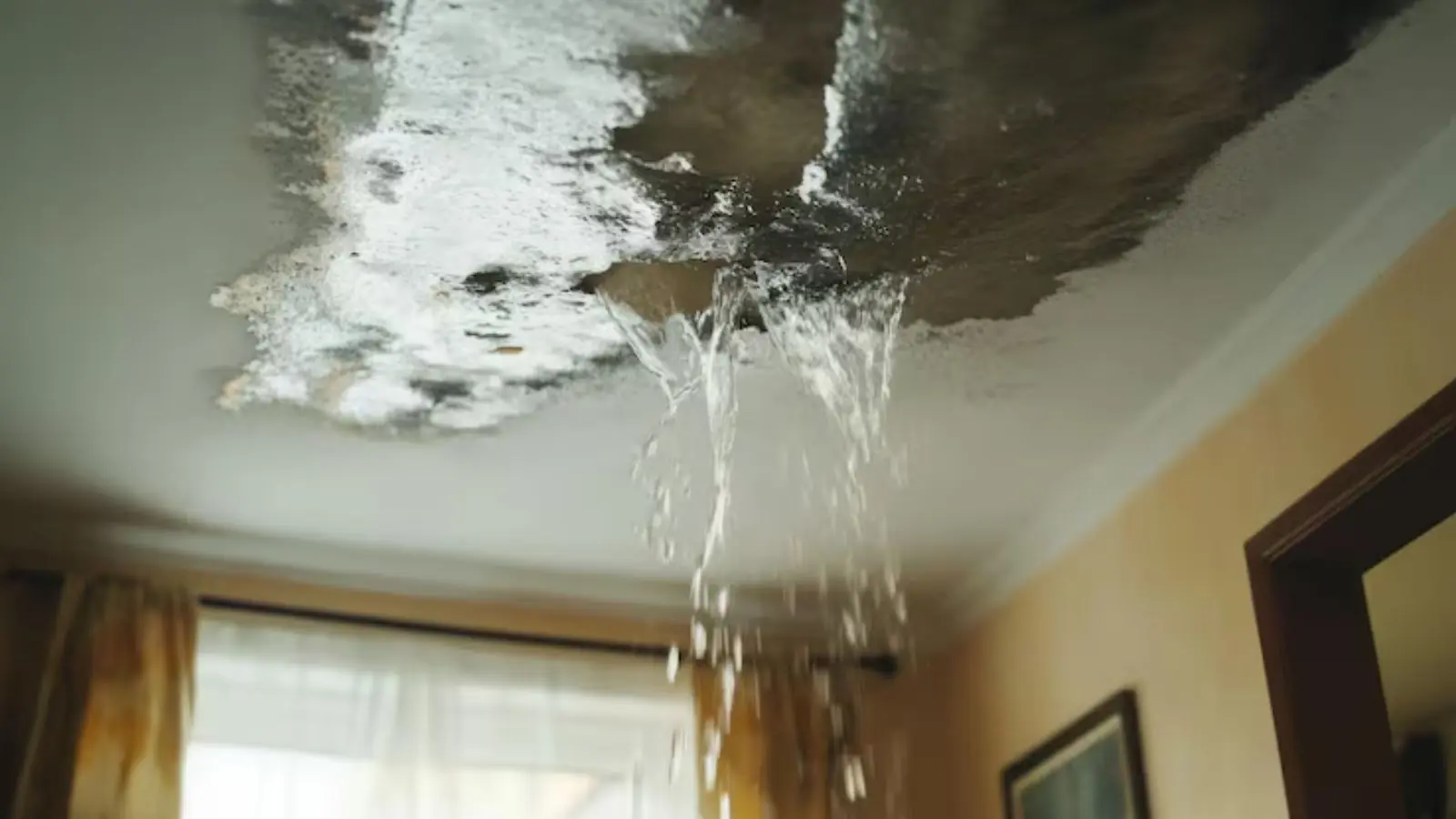
A dripping or bulging ceiling is an emergency. The weight of trapped water can bring drywall down, and water moving through ceiling cavities can reach light fixtures and wiring. Acting in the first hours limits damage to the ceiling, the insulation above and the floor below.
This guide covers the safe steps in order, and how to decide who to call first.
Safety first
If the water is reaching a light fixture, ceiling fan or outlet, do not use that switch. Turn off power to that circuit at the panel only if you can reach it while standing on dry ground. If you smell burning or see sparks, leave and call 911 or your utility first.
Step by step: what to do now
- Clear the floor. Move furniture and valuables away from under the leak. Cover large items with plastic.
- Place a bucket and tarp. Catch drips and protect the floor from splashing.
- Find the source. Is it above a bathroom, kitchen or laundry, or is it raining outside?
- Stop the water if it is plumbing. Close the fixture valve or the main valve.
- Relieve a bulge carefully. If a ceiling is bulging with water, stand to the side, not under it, and poke a small hole at the lowest point of the bulge with a screwdriver, with a bucket below, so the water drains in a controlled way.
- Photograph everything and call the 24/7 line.
Relieving a bulge is a judgment call. If the ceiling looks ready to collapse, leave the area and call for help rather than reaching under it.
Ceiling dripping or bulging right now? Call and describe it.
☎ Call (760) 769-1159Who to call first: roofer or restoration crew?
| If this is true | Call first | Then |
|---|---|---|
| It is raining and water enters near an exterior wall or roof valley | A roofer for a temporary cover | Restoration for water removal and drying |
| A fixture above is leaking, like a bathroom or kitchen | A plumber, or shut off the valve yourself | Restoration for extraction and drying |
| The AC unit is dripping into the ceiling | Turn off the unit, then an HVAC technician | Restoration if drywall is wet |
| You do not know the cause | Our 24/7 line, and we help sort it out | The right trade for the source |
Restoration crews do not repair roofs or plumbing, and we say so on the first call. What we do is remove the water, open wet ceilings that need to drain, dry the cavity and protect the room. The source still needs its own trade.
After drying, rebuilding is handled under water damage repair, and for the drying itself see water mitigation.
What happens in the first 24 hours
Within the first day the crew drains trapped water, removes saturated insulation, opens soft drywall and begins drying. Moisture readings establish a baseline and the equipment runs from that point.
If you wait, wet insulation stays wet and the ceiling drywall softens. A small leak that reaches that stage becomes a larger repair, and the room below can pick up mold risk.
After the water is out: what not to do
- Do not paint over the stain. Paint traps moisture and hides a wet cavity.
- Do not turn on a ceiling fan or light fixture that was wet until it has been checked.
- Do not walk into the attic above the leak without a safe path on the joists.
- Do not sweep or vacuum wet insulation. Wet insulation is heavy and sheds fibers when disturbed.
- Do not wait for the stain to stop growing before calling. A stain that stops can still hide wet material.
Once the water is controlled, drying starts and the damaged section is opened if it will not dry in place. Keep photos of each stage for your records.
Ceiling leaks and storm drainage in Poway
Lake Poway sits inside Poway Community Park behind a dam built in 1972. In 2017 heavy rain brought the lake close to the top of the dam without a spill, and in 2019 heavy rain backed up a storm water pipe at the lake's treatment facility. Those events are a reminder that concentrated storms can stress local drainage.
Homes on slopes can see water move along roof edges and valleys toward interior walls. Photograph the outside when the rain slows, since flashing and valley problems often show only in wet weather, and give the roofer those photos.
We take these calls in Escondido and Ramona as well, with the same safety steps and a dispatcher who stays on the line until help is arranged.
Questions homeowners ask
If water is entering from the roof, a roofer can cover the opening, but the water already inside needs removal and drying. Call our 24/7 line at (760) 769-1159 for the interior water and we help sort out the sequence.
It can be, if you stand to the side, keep a bucket below and the area is clear of electrical hazards. If the ceiling looks ready to collapse, leave and call for help.
Only at the panel and only if you can reach it standing on dry ground. If water reaches a fixture, do not use that switch.
In warm, closed spaces it can begin within a day or two of wetness. Fast drying lowers the risk.
Often when the cause is sudden and accidental. Check your policy and photograph the damage.
Ceiling still dripping? Stop reading and call the 24/7 line.
☎ Call (760) 769-1159